Furnace Guides and Resources
Plain explanations of how furnaces work, what goes wrong, what is safe to check yourself, and how to weigh a repair against a replacement.
Guides and calculators
Furnace Repair vs Replacement Calculator
Enter your own estimates, age, repair history and efficiency to compare the two options. No invented Akron prices.
Open the calculatorFurnace Repair Cost Guide for Akron Homeowners
Furnace repair cost is driven by four things: which component failed, whether that part is commonly stocked or must be ordered, how much labor the access and diagnosis require, and whether the failure is a symptom of a second problem such as restricted airflow. Published averages vary widely by source and rarely reflect a specific home, so the useful number is the written estimate for your furnace. Use that figure, plus a replacement estimate, in the calculator rather than a generic average.
Read the guideFurnace Repair vs Replacement in Akron, OH
Repair generally deserves consideration when a furnace is not near the end of its expected life, has a clean repair history, and the estimate is small relative to replacement. Replacement deserves consideration when age, repeat repairs, a large current estimate, poor efficiency, unresolved comfort problems or a safety-related finding stack up together. Treat the widely repeated 50 percent rule as one input, not a verdict.
Read the guideFurnace Replacement Cost Factors in Akron, OH
Furnace replacement cost depends on equipment capacity and efficiency, blower type, venting requirements, condensate handling, duct and filter modifications, electrical and gas work, access difficulty, and whether the installer commissions the system with documented measurements. Comparing quotes requires comparing scope, not just the bottom line. We do not publish invented Akron pricing; use your real quotes in the calculator.
Read the guideHow Long Do Furnaces Last in Akron Homes?
Gas furnaces commonly reach roughly 15 to 20 years, and electric furnaces often last longer because they have no combustion components. Actual life depends heavily on installation quality, sizing, airflow, filter discipline and maintenance. A long heating season adds runtime, so identical furnaces age differently in different homes. Planning replacement in the later years is easier than deciding during a February failure.
Read the guideFurnace Maintenance Checklist for Akron Homes
Homeowner tasks: check the filter monthly during heating season, keep registers and returns clear, keep the furnace area clear, keep outdoor vent terminations free of snow and ice, and test carbon monoxide alarms per their manufacturer's instructions. Technician tasks: combustion and flame-sensing checks, temperature rise, blower amp draw, safety control verification, venting and condensate inspection.
Read the guideFurnace Filter Guide for Akron Homes
Match the filter size printed on the existing filter or the furnace's filter rack, then choose a MERV rating your system can breathe through. Higher MERV filters capture more but restrict more airflow, and in a system with limited return capacity that restriction causes short cycling, limit trips, weak airflow and uneven heating. Check 1-inch filters monthly during heating season; thicker media filters typically last longer.
Read the guideFurnace Repair FAQ for Akron Homeowners
Most furnace questions come down to four categories: is this safe, is this normal, is this repairable, and is it time to replace. Safety questions involving gas odor or carbon monoxide alarms always go to the gas utility or emergency services first. Everything else starts with the symptom, the thermostat and the airflow path.
Read the guideFurnace Troubleshooting Guide for Akron Homes
Safe troubleshooting follows one order: confirm the thermostat is calling for heat, confirm the furnace has power at the breaker and service switch, confirm the access panel is closed, check the filter and airflow path, then observe what the furnace does when it tries to run and note any diagnostic flash code. Stop there. Gas, combustion, venting and safety circuits require a technician.
Read the guideFurnace Maintenance Tips for Akron Winters
The highest-value habits are filter attention during heating season, keeping every register and return grille clear, keeping high-efficiency vent terminations free of snow and drifting, using moderate thermostat setbacks rather than deep ones, and scheduling annual service in early fall before sustained cold weather.
Read the guideGas vs Electric Furnace in Akron, OH
Gas furnaces generally cost less to operate in this region and are a common choice where natural gas service exists, but they require venting, combustion air and combustion-related maintenance. Electric furnaces cost less to install, need no venting, and have simpler maintenance, but resistance heat typically costs more per unit of heat. Repair profiles differ: gas failures cluster around ignition and flame sensing, electric failures around elements and sequencers.
Read the guideHigh-Efficiency Furnace Guide for Akron Homes
AFUE describes the share of fuel energy a furnace converts to usable heat over a season. Condensing furnaces reach higher AFUE by extracting additional heat from exhaust gases, which produces condensate that must drain and requires PVC venting instead of a chimney. Real-world savings depend on runtime, so a long heating season improves the case. Staging and variable-speed blowers affect comfort as much as efficiency ratings do.
Read the guideWhy Your Heating Bills Increase in Akron, OH
Heating bills rise when the furnace runs longer, when it produces heat less efficiently, or when rates change. Common causes include colder weather and more heating degree days, restricted airflow from a loaded filter, duct leakage into unheated space, thermostat settings and long recovery from deep setbacks, aging equipment operating outside design ranges, and air leakage or insulation gaps in older homes.
Read the guideUneven Heating in Akron Homes
Uneven heating comes from unequal air delivery and unequal heat loss. Long or undersized duct runs, leaky ducts in unheated space, too little return air, closed doors, and stack effect in two-story homes cause unequal delivery. Rooms over garages, additions, and corner rooms lose more heat. Correcting airflow and balancing usually helps more than replacing equipment.
Read the guide
Symptom guides
- Furnace Won't Turn On in Akron, OH
- Furnace Blowing Cold Air in Akron, OH
- Furnace Short Cycling in Akron, OH
- Furnace Keeps Running in Akron, OH
- Furnace Keeps Shutting Off in Akron, OH
- Furnace Making Noise in Akron, OH
- Furnace Not Heating Evenly in Akron, OH
- Furnace Ignition Repair in Akron, OH
- Furnace Flame Sensor Repair in Akron, OH
- Furnace Blower Motor Repair in Akron, OH
- Furnace Thermostat Problems in Akron, OH
- Furnace Smells in Akron, OH
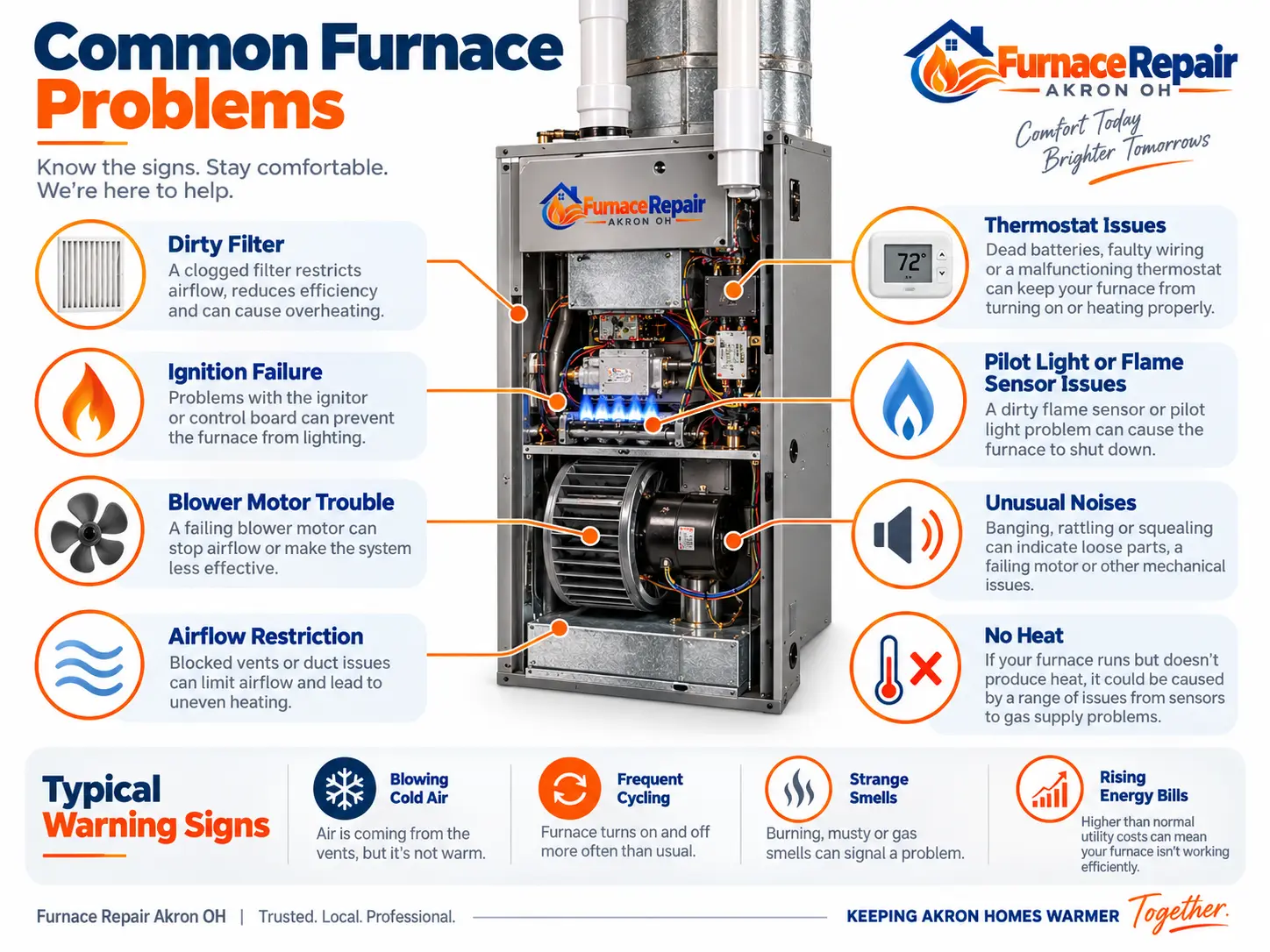
Common furnace problems at a glance: dirty filters, ignition failure, blower motor trouble, airflow restriction, thermostat issues, flame sensor problems, unusual noises and no heat. Each of those has a dedicated guide above.