Furnace Troubleshooting Guide for Akron Homes
Work in order, stay inside safe limits, and collect the clues a technician will ask for.
Call now FOR FREE QUOTE and for service availability.
Please have your 5-digit ZIP code ready.
Quick answer
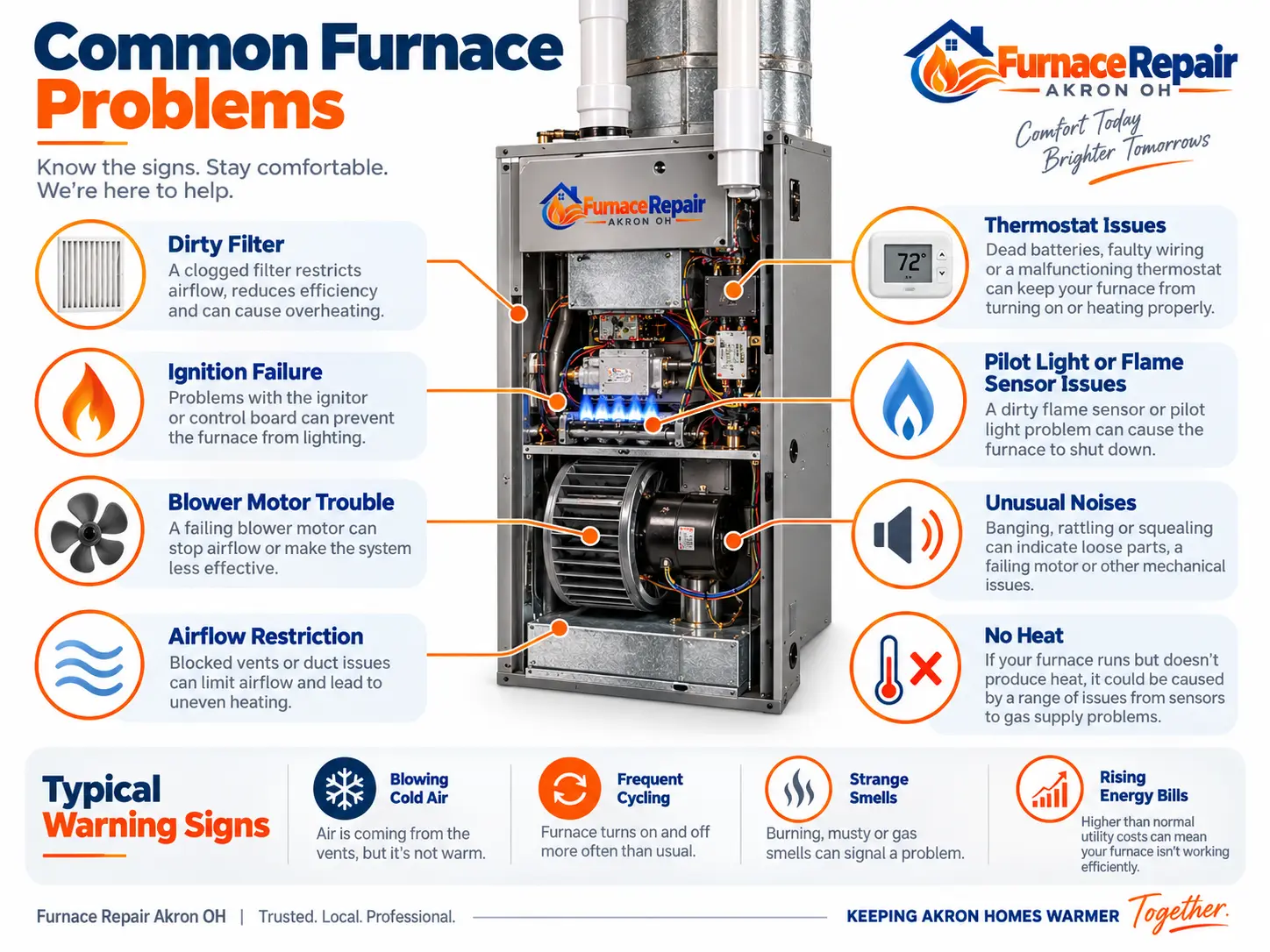
Safe troubleshooting follows one order: confirm the thermostat is calling for heat, confirm the furnace has power at the breaker and service switch, confirm the access panel is closed, check the filter and airflow path, then observe what the furnace does when it tries to run and note any diagnostic flash code. Stop there. Gas, combustion, venting and safety circuits require a technician.
Step 1: the heating call
- Mode set to Heat, setpoint above room temperature.
- Display alive; replace batteries if dim or blank.
- Fan set to Auto rather than On while you diagnose.
Step 2: power and access
- Furnace breaker fully on.
- Service switch near the furnace on.
- Access panel seated so the door switch closes.
Step 3: airflow
- Filter inspected and replaced per manufacturer guidance if loaded.
- All supply registers open, return grilles clear.
- Outdoor vent terminations on high-efficiency furnaces clear of snow and ice.
Step 4: observe and record
| What you observe | What it suggests | Where to read next |
|---|---|---|
| Complete silence | No call or no power | Furnace won't turn on |
| Fan only, cool air | Ignition or flame sensing | Furnace blowing cold air |
| Lights, quits in seconds | Flame sensing | Flame sensor repair |
| Runs minutes, then quits | Airflow and limit trip | Furnace short cycling |
| Clicking, no flame | Ignition system | Furnace ignition repair |
| Noise | Blower, ignition, ducts | Furnace making noise |
| Odors | Dust, electrical, or gas | Furnace smells |
Hard stops
- Never bypass limits, pressure switches or interlocks.
- Never manipulate gas valves or gas piping.
- Never disassemble burners or open sealed combustion compartments.
- Never modify venting or attempt heat exchanger repairs.
- Strong gas odor: leave the home and contact the gas utility or emergency services from a safe location.
- Carbon monoxide alarm: follow the alarm manufacturer's emergency guidance, leave the area if directed, and contact emergency professionals.
Related furnace guides
Frequently asked questions
- What kinds of furnace problems come up most?
- Common problems include airflow restriction and thermostat issues, along with ignition and flame-sensing failures on gas furnaces.
- Should I write down the flash code?
- Yes. Record the pattern before cutting power, since it narrows the diagnosis considerably.
- How many times can I reset the furnace?
- Once, to see whether it was a one-time event. Repeated resets hide the underlying cause.
Talk through your furnace problem
Describe what your furnace is doing and we can go over next steps for your home.
Call now FOR FREE QUOTE and for service availability.
Please have your 5-digit ZIP code ready.
Request Service
Send your furnace details and we will follow up about next steps and current service availability for your ZIP code.