Not every no-heat situation is a failed part. A meaningful share of calls trace back to something in plain sight: a thermostat in the wrong mode, dead batteries, a switch someone flipped, a breaker, or a filter that has not been changed in a long time.
The checks below are safe for a homeowner and take a few minutes. If they do not resolve the problem, you will at least be able to describe the symptom precisely, which shortens diagnosis. Where the list stops, it stops for a reason: furnaces involve gas, combustion byproducts and line-voltage electricity.
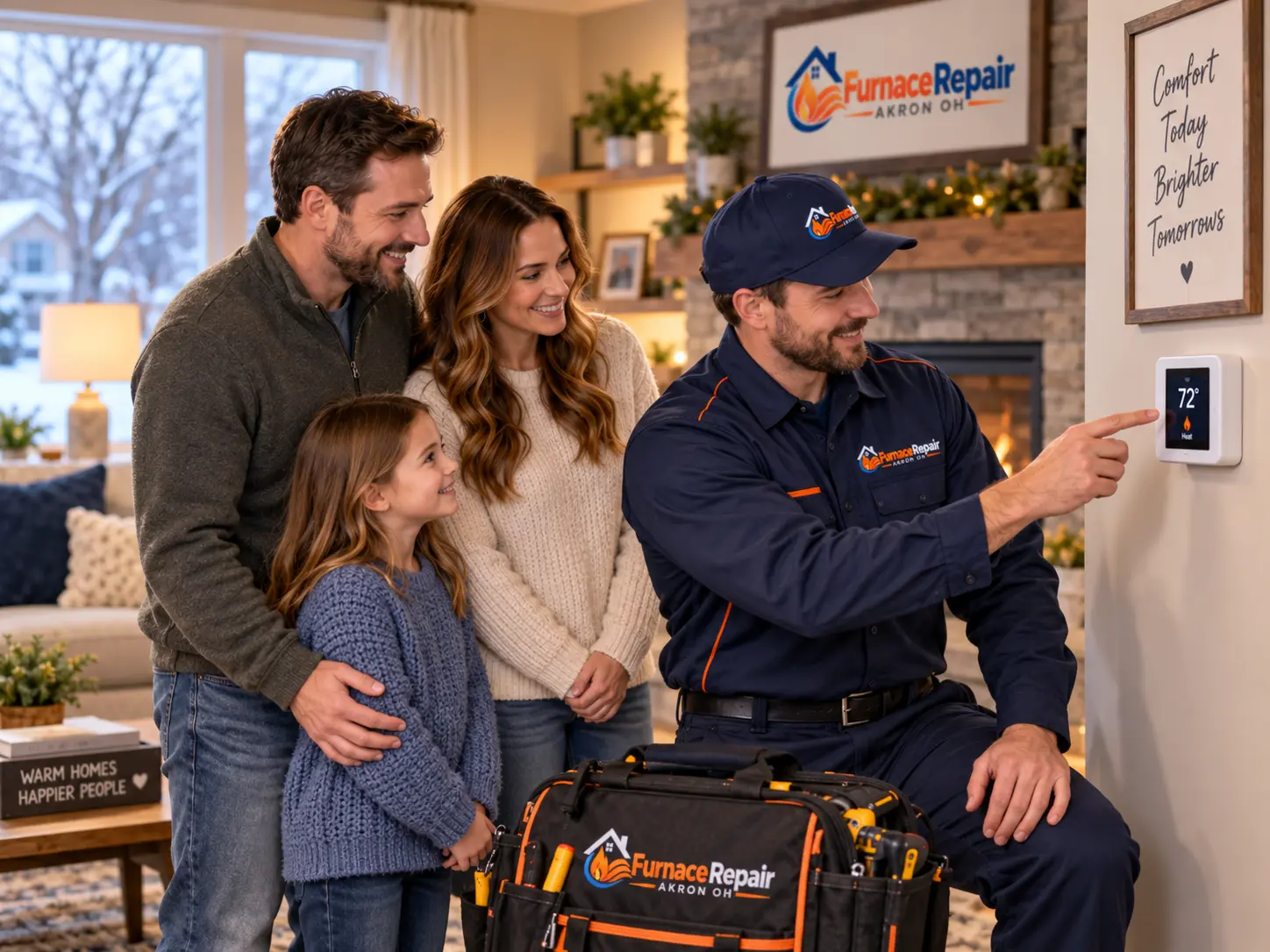
Start at the thermostat
Mode
Confirm the thermostat is set to Heat, not Cool, Off or Auto with a setting that will not call for heat. Also check the fan setting: Fan On circulates air continuously, which makes a normally functioning furnace feel like it is blowing cool air between heating cycles.
Temperature
The setpoint has to be above the current room temperature by enough to trigger a call. Raise it a few degrees and listen for the furnace to respond within a minute or two. Many smart and programmable thermostats also have a schedule or a hold that overrides what you just set.
Batteries and display
A blank, faded or frozen display is a strong hint. Replace the batteries if the thermostat uses them. A thermostat that has lost power cannot call for heat, and from inside the house that is indistinguishable from a broken furnace.
Check power to the furnace
- Find the furnace service switch, which looks like an ordinary light switch on or near the furnace, and confirm it is on. These get switched off accidentally during cleaning, storage or other work.
- Check the breaker labeled for the furnace or air handler in the electrical panel. If a breaker has tripped, you can reset it once. If it trips again, stop and call — a repeating trip is a fault, not a nuisance.
- If the furnace is in a space with a light or outlet on the same circuit, note whether those also lost power.
Check the air side
The accessible filter
If the filter is in an easy location such as a return grille or a slot at the furnace cabinet, look at it. A filter loaded with dust restricts return air, which can cause overheating, early shutdowns and weak airflow. Replace it with the same size and orientation, following the manufacturer's guidance and the airflow arrow.
Supply vents
Walk the house and confirm supply registers are open and not covered by furniture, rugs, curtains or boxes. Closing vents in unused rooms does not save much and can create pressure and distribution problems.
Return vents
Return grilles are frequently blocked by a sofa or a bookshelf. A furnace cannot deliver more air than it can pull back, so a blocked return affects every room.
Look, but do not touch
A few observations are genuinely useful to report, and none of them require opening anything up or handling components.
- Is there an obvious error indicator — a flashing LED, a blinking pattern visible through the sight window, or a code on a display? Note the pattern.
- Does the furnace attempt to start at all: a fan noise, a click, a whoosh, then silence?
- Do burners light and then quit after a few seconds?
- Is there water on the floor near a high-efficiency furnace?
- Do other gas appliances in the home appear to be behaving normally? Observe only — do not relight, adjust, disassemble or otherwise manipulate any gas appliance or its controls.
Hard safety limits
Everything below is outside homeowner scope regardless of skill level or what a video suggests. These components exist to prevent fires, carbon monoxide exposure and electrical injury.
- Do not bypass, jumper or defeat limit switches, pressure switches, rollout switches, door interlocks or any other safety device.
- Do not open burner compartments or sealed combustion compartments.
- Do not adjust, tap, clean or manipulate gas valves or gas piping.
- Do not jumper terminals on a control board to force operation.
- Do not repair, splice or reroute furnace wiring.
- Do not adjust burners, gas pressure or air shutters.
- Do not attempt heat exchanger or venting repairs, patches or modifications.
- Do not repeatedly reset a furnace that keeps locking out; the lockout is reacting to a real condition.
If you smell a strong gas odor
Do not look for the source, do not operate switches and do not use anything that could ignite. Get everyone out of the home, then contact the gas utility or emergency services from a safe location outside. If a carbon monoxide alarm sounds, follow the alarm manufacturer's emergency guidance, leave the area if directed, and contact emergency professionals.
What to have ready when you call
- Your 5-digit ZIP code.
- What the furnace is doing, in your own words, and when it started.
- Whether the behavior repeats or happened once.
- Any error light pattern you noted.
- Which of the checks above you already completed.
- Roughly how old the furnace is, if you know.
Related Furnace Guides
Talk through your furnace problem
Describe what your furnace is doing and we can go over next steps for your home.
Call now FOR FREE QUOTE and for service availability.
Please have your 5-digit ZIP code ready.
More guides on the furnace repair blog.